


Fix IT in Digital Healthcare International Prize
When digital healthcare works, it’s amazing. We rapidly developed vaccines against COVID using cutting-edge technology, and then our NHS vaccinated and boosted millions of people across the UK and kept track of everything using digital technology. Apps were just the public face of this.
We often overlook how effective digital is: people who are diabetic use computerised insulin pumps; heart patients use computerised pacemakers; patients in hospitals have infusion pumps, X-rays, MRI scans; then there’s all the laboratory equipment … and much more. Even to have a video consultation, modern healthcare completely relies on digital.
It would be wonderful if all digital healthcare was always so impressive and risk-free all the time, but sometimes digital goes wrong, and causes problems for both patients and staff.
Interoperability, paperwork, workarounds, delays, and losing data are all-too-familiar problems. Features like ‘cut and paste’, which is intended to make life easier, ends up helping create patient records that are just full of endlessly repeated information that is counter-productive.
At the Royal College of Physicians annual conference, Medicine 2022, Professor Harold Thimbleby announced a new annual international prize to help encourage a real improvement to patient safety and staff well-being through digital innovation.
This prize was developed by and is supported by an exciting and innovative collaboration between the Royal College of Physicians, the Faculty of Clinical Informatics and the Institution of Engineering Technology — we will only get a real improvement in digital healthcare when healthcare professionals and engineers collaborate closely.
The prize is inspired by Prof Thimbleby’s book, Fix IT: See and solve the problems of digital healthcare (Oxford University Press, 2021), which was published in November 2021. The book is described briefly below.
The £5,000 annual prize is awarded for digital improvements that improve safety for patients or well-being for staff and which can be adopted widely.
Improvements to processes and systems are included in the scope of the prize, including making improvements to ways of investigating digitally-related incidents, improving standards, improving digital qualifications or recruitment — and more.
- Note that apps and medical devices, to be competitive, will typically need to have an impact wider than a particular speciality — entries will generally want to show how their ideas can be replicated, and hence can contribute to improving healthcare more widely.
- One way to have wider impact also might be for developers to explain how their methods can help all developers build safer digital.
- Since digital is racing ahead beyond all our comprehension, the Fix IT prize also encourages entrants to think of solutions, criteria, or types of improvement that the judges haven’t — so this list is deliberately not exhaustive.
- The entry form is deliberately simple and easy to complete to encourage applicants. (Shortlisted submissions will be asked for further information.)
To register interest or to be notified of deadlines, click http://www.harold.thimbleby.net/fixit/prize
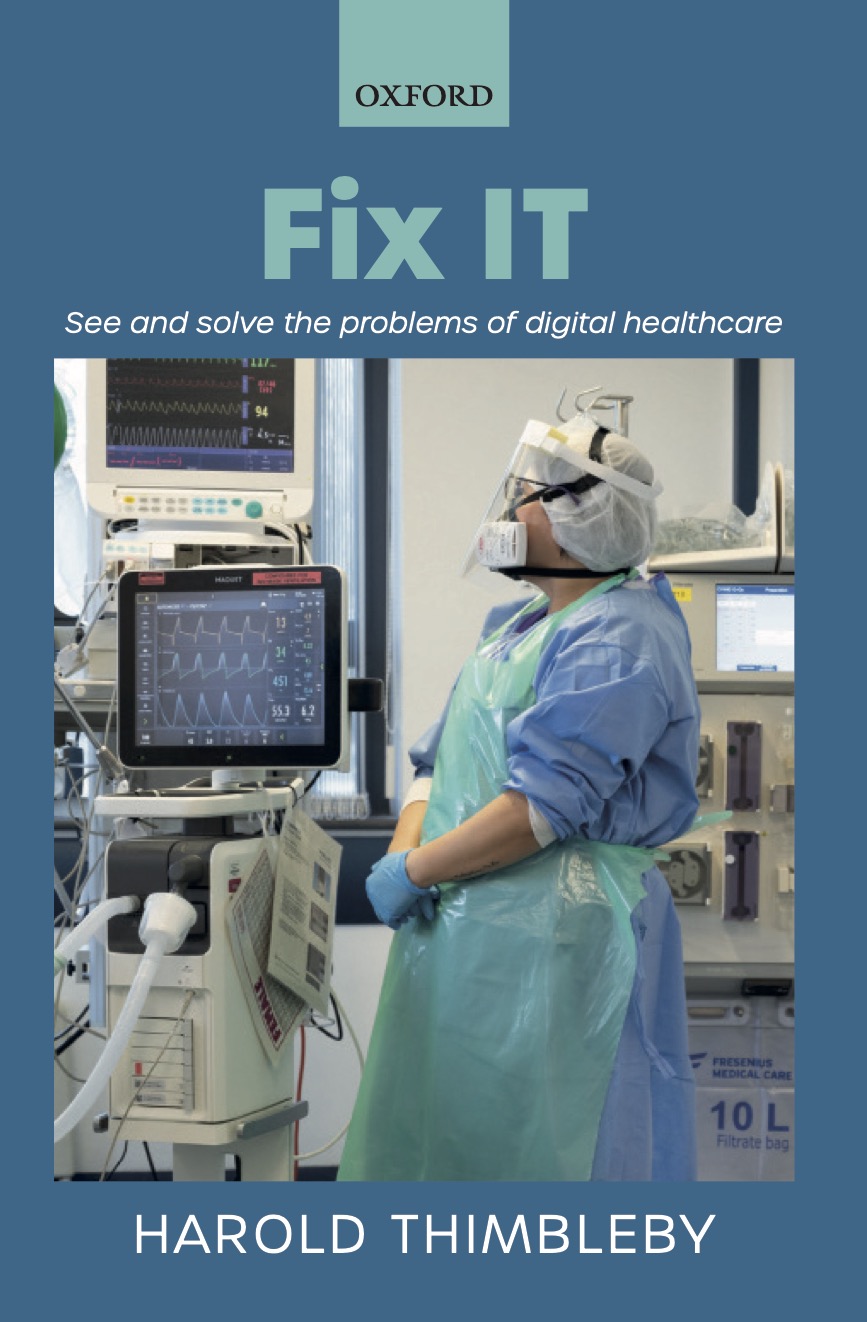

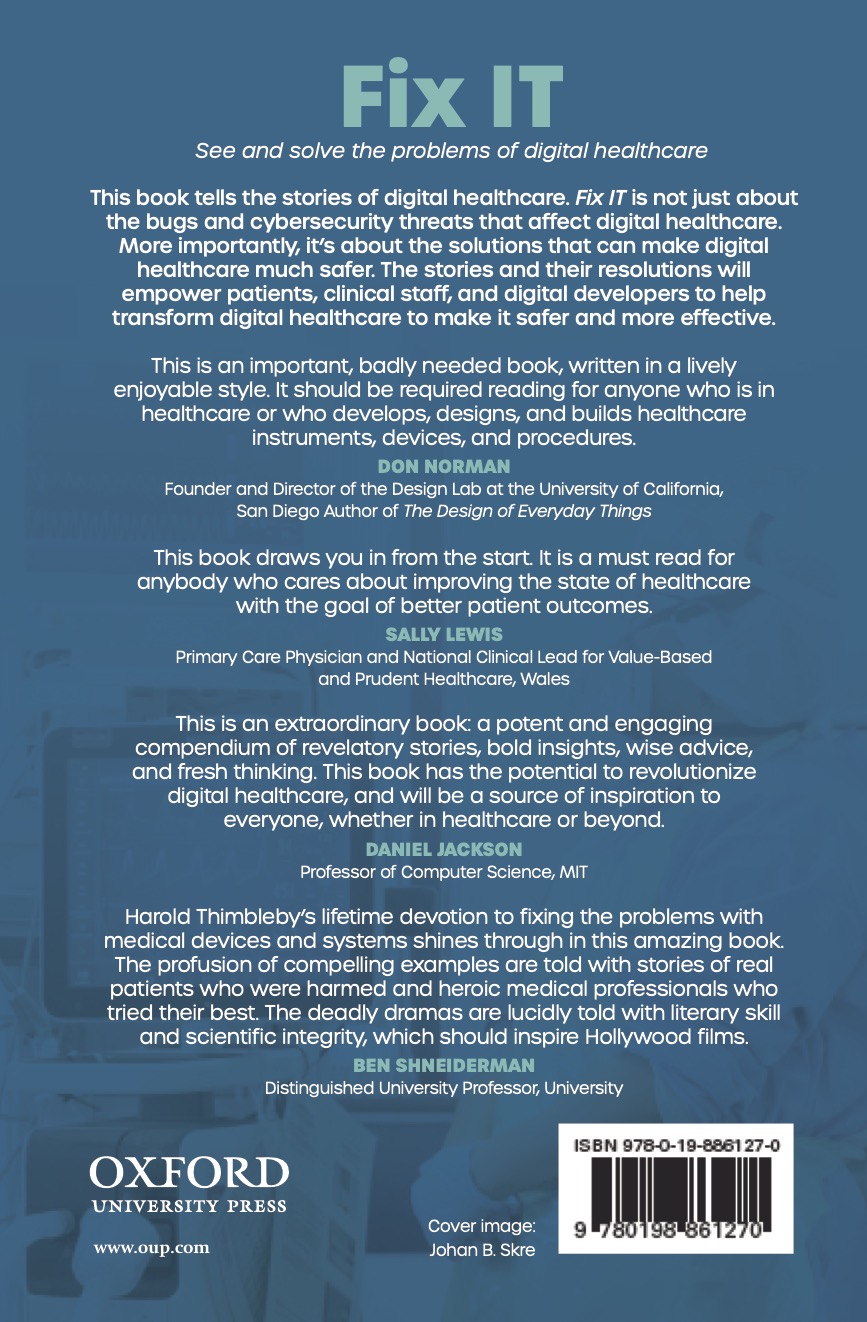
“This is a brilliant and hugely enjoyable book which should be compulsory reading for anyone with high-level responsibility for patient care.” — Martin Elliott, former Medical Director, Great Ormond Street Hospital for Children
“This is an extraordinary book: a potent and engaging compendium of revelatory stories, bold insights, wise advice, and fresh thinking.” — Daniel Jackson, Professor of Computer Science, MIT
Fix IT is divided into three parts, each full of stories and insights:
| Part 1 | – | Diagnosis | – | Digital healthcare is much riskier than we think; |
| Part 2 | – | Treatment | – | Solutions; |
| Part 3 | – | Prognosis | – | The better futures. |
About the author
Prof Harold Thimbleby is See Change Fellow in Digital Health, based at Swansea University, Wales. He is Expert Advisor on IT to the Royal College of Physicians, a member of the World Health Organization’s Patient Safety Network, and an advisor to the Clinical Human Factors Group and to the UK Medicines Healthcare products Regulatory Agency (MHRA). Although a professor of computer science, he is an Honorary Fellow of the Royal College of Physicians, the Edinburgh Royal College of Physicians, and of the Royal Society of Arts; he’s also a fellow of the Royal Society of Medicine. He has been a Royal Society-Wolfson Research Merit Award Holder and a Leverhulme Trust Senior Research Fellow, and he is 28th Gresham Professor of Geometry.
Harold won the British Computer Society’s Wilkes Medal. His last book, Press On: Principles of Interaction Programming (MIT Press), won several international awards.
Harold is a popular speaker, and has given nearly 600 presentations in over 30 countries. He is a regular expert witness covering digitally-related cases.